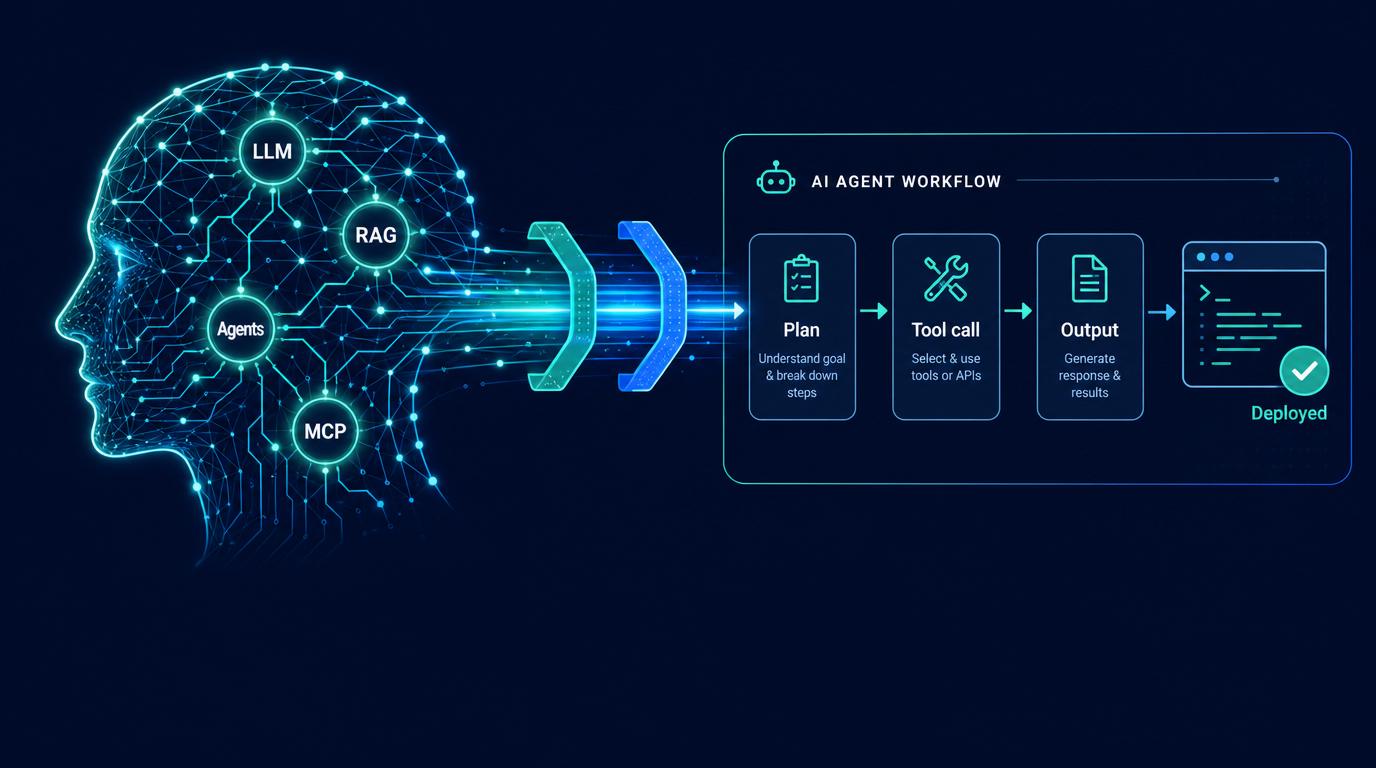
This program helps you transform from a user of AI into an architect of AI systems, capable of building thinking software for real-world business problems.
- Move beyond simple prompts to architect autonomous AI agents
- Build digital employees that plan and execute complex tasks
- Bridge private company data with AI, securely
- Ground AI responses in fact, not guesswork
- Master Model Context Protocol (MCP) to connect AI to any database or tool
What will you learn?
Week 1 & 2
The Architectural Shift
Move from predictive machine learning models to autoregressive reasoning systems, and build a strong mental model of how modern Generative AI works in enterprise computing.
Traditional ML vs. GenAI: Understand the paradigm shift in feature engineering, classification, and linguistic semantic understanding that separates classic ML from Large Language Models (LLMs).
LLM vs. SLM Footprint: Learn when to deploy highly parameterized cloud-based LLMs versus localized, specialized small language models (SLMs).
Context Window Economics: Track token limits, structured output generation, schema validation, and inference latency — the practical cost mechanics behind every LLM call.
Week 3
Enterprise RAG Stack
Semantic Chunking
Learn parent-child mappings and semantic splitting over raw character bounds, so retrieval preserves structural context instead of fragmenting it.
Vector Databases
Understand scalable vector database indexing. Build metadata-aware queries, explore HNSW parameters, and execute fast semantic retrieval — core skills for any production RAG pipeline.
Retrieval & Reranking
Improve accuracy with a two-stage retrieval pipeline: fast vector index search first, followed by cross-encoder rerankers for precision.
Week 4
Grounding & Mitigation
99.8% — Grounding Accuracy Target
Defeating Hallucinations at Scale
Enterprise-grade AI systems need to be deterministic and reliable. Go beyond basic prompting to build systems that don't hallucinate in production.
Rigid Prompt Engineering: Apply context boundary constraints, system instructions, and negative constraint guidance for consistent outputs.
Reference & Citation Rules: Programmatically validate outputs against source document ID schemas.
Dynamic Guardrails: Build self-correction loops, secondary verification, and real-time validation layers.
Week 5: Agentic Loops & Autonomy
Building Goal-Oriented Systems
Shift from linear, rule-based code to autonomous AI agents that plan and execute complex, multi-step tasks within defined boundaries.
Planner / Executor: Design ReAct-style planning paradigms and action scratchpads.
Dynamic Tool Calling: Generate tool schemas programmatically and wire up API bindings.
State & Memory: Implement episodic memory, session context, and long-term storage for agents.
Week 6: Multi-Agent Systems
Supervisor-Worker Model
Learn to design hierarchical multi-agent systems where a central supervisor evaluates requests, decomposes complex goals, delegates narrow tasks to specialized agents, and reviews their output.
Specialization & Orchestration
Understand why narrow, focused worker agents outperform generalist ones. Master communication structures, shared state across multi-turn sessions, and orchestration patterns used in real agentic workflows.
Week 7: Model Context Protocol
Universal Standard for AI Context — Learn Anthropic's Model Context Protocol (MCP), the open JSON-RPC standard that lets AI applications discover tools, resources, and reusable prompts securely.
MCP Client-Server Architecture — Understand how host processes manage client handshakes, capability negotiation, and lightweight stateless servers.
Enterprise Tool Integration — Skip writing custom REST hooks. See how MCP dynamically connects AI agents to databases, local file systems, and external APIs.
Week 8: Capstone & Production Scale
From Prototype to Production
Bring everything together into one deployable, full-stack AI application — proof that you can ship production-grade GenAI systems, not just demos.
Capstone Project: Build a full-stack agentic application combining your RAG pipeline, multi-agent orchestration, and live MCP tool connections.
Deployment & Scaling: Package and deploy your capstone to a live environment — covering configuration, logging, monitoring, and reliability checks.
Job-Ready Delivery: Walk through your capstone in a portfolio-review and mock interview session, so you're ready to present it to employers.